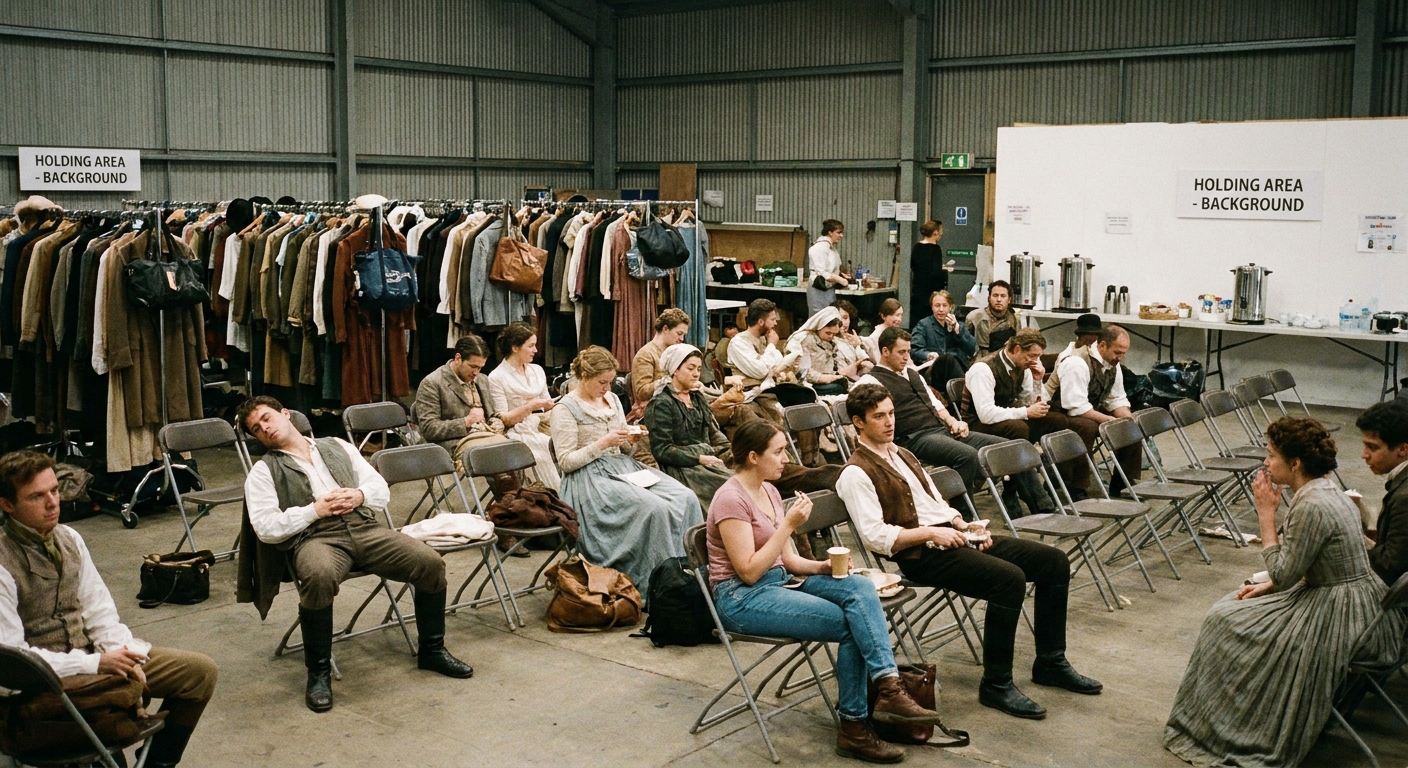
I have read more casting texts and emails than I care to admit, and the one thing that still makes even seasoned background performers squint at their phones is the wording. You submit, you wait, and then casting replies with a two-word status that feels like it should come with a decoder ring.
So let’s decode the three big ones you will see after you submit for background work: avail, hold, and booked. These words are not just vibes. They describe where production is in its decision-making, what they are asking of your schedule, and what you should do next.
The short version
- Avail means: Are you truly available? Casting is checking your schedule. You are not hired yet.
- Hold means: Please keep this date and time open while we try to finalize. You still might not be hired.
- Booked means: You are hired. Treat the date as committed and follow the details you are given.
Those definitions are broadly true across film, TV, commercials, and new media. But terminology can vary by market, union status, and casting office, so pay attention to the exact language they use. The real-life difference comes down to what you are allowed to accept next and how hard you should protect the date.
What “avail” means
Avail is shorthand for availability check. Casting is asking whether you can do the job if they offer it. In many offices, “Are you on avail?” is essentially, “Can you confirm you are free before we put you into the puzzle?”
One important wrinkle: some offices use an avail like a soft hold. If they do, they will usually say something like “do not take other work” or “we may book you, please stay open.” When in doubt, ask.
What it commits you to
Usually, not much. An avail is not a promise of work, and it is not typically a formal commitment on your end. It is a checkpoint in the casting process.
When you are free to take another job
With an avail, you are generally still free to accept other work. The professional move is to be honest about your schedule. If you take another gig that conflicts, update casting right away so they can adjust.
How to respond
- Confirm quickly, clearly, and with the specific date and time window if one was mentioned.
- If you are only partially available, say so. Do not “yes” your way into a conflict.
- If you have another hold or booking pending, mention it briefly.
Sample reply: “Hi, yes, I’m available for Tues 10/3 and can be on set all day. Please let me know if you need anything else.”

What “hold” means
Hold is the phrase that causes the most anxiety because it sits in the middle. Casting wants you to keep a date open while they finalize decisions. It is more serious than an avail and less final than a booking.
You might see variations like “first hold,” “weather hold,” “soft hold,” or “select hold.” The exact label is office-specific, but the intention is the same: production is trying to protect options.
What it commits you to
A hold is a good faith commitment to remain available. In plain language: if you agree to the hold, you should not casually schedule over it.
That said, a hold still is not a guarantee you will work. Production may release you, change the plan, or never convert the hold into a booking.
When you are free to take another job
This is where it gets nuanced:
- If another job comes in that conflicts, you can often take it only after you ask the original casting office to release you from the hold or confirm they are not booking you.
- If you accept conflicting work without communicating, you risk being labeled unreliable. Background casting is relationship-driven and memories are long.
- “Conflicting” is not just call time on paper. It includes travel time, parking, checking in, and the fact that a “short day” can turn into overtime. Do not stack tight call times and hope for a miracle wrap.
How to respond
- Confirm you are holding the date and restate the date and any time range.
- Ask what the expected decision time is, if it was not included. A simple “When do you expect to confirm?” is appropriate.
- If you have a narrow window, disclose it upfront. “I can hold until 6 pm tonight, then I have to commit elsewhere” is better than disappearing.
Sample reply: “Confirmed, I’m holding Wed 10/4 (available all day). When do you expect to know if this will be confirmed?”

What “booked” means
Booked means you are hired. This is the status that turns your calendar from pencil to ink.
Depending on the production, you may be booked for a specific day, for a fit and shoot, or for a range of dates if it is a recurring background need. The details matter, and they should be spelled out in the booking message or follow-up paperwork.
What it commits you to
A booking is a commitment to show up as instructed, on time, prepared, and ready to follow set protocols. If there is wardrobe, paperwork, or specific health and safety policies in place, you are committing to that process too.
When you are free to take another job
Once you are booked, you are not free to take conflicting work for the booked time period, including likely overtime windows if the booking notes that the day may run long. Background days regularly stretch.
If you truly have an emergency or a conflict you missed, contact casting immediately. “Booked and hoping it works out” is not a strategy. It is how you get replaced.
What you should receive with a booking
- Call time and location, or when and how those will be sent
- Wardrobe instructions, if any
- Pay rate and voucher process, if applicable
- Any special requirements like bringing ID, specific shoes, or a clean-shaven look
Sample reply: “Thank you, confirmed booked for Fri 10/6. I’ll be there. Please send call time and wardrobe notes when available.”
Common variations you may see
Casting language is not fully standardized, so here are a few terms that often appear alongside avail, hold, and booked.
“Select”
This often means you are being strongly considered, sometimes in a smaller group. It is still not a booking.
“Check avail” or “Confirm avail”
Same family as avail, but it can signal urgency. They may be close to locking.
“On hold” vs “First hold”
In some markets, “first hold” can mean you are their top choice among holds, but not confirmed yet. In others, it is simply internal phrasing. Either way, treat it like a hold and protect the date.
“Released”
Good news for your calendar. It means you are no longer needed for that hold and you can take other work freely.
“Booked pending”
This can mean “you are likely to book, but we are waiting on final approval, paperwork, or a schedule lock.” Treat it like a hold until you get a clear “booked/confirmed” and the details you need. If you are unsure, ask what is still pending and when they expect to confirm.
A simple timeline
If you like a narrative arc, here is the typical flow:
- Submission sent
- Avail check to confirm you are truly free
- Hold while production finalizes numbers, scenes, or approvals
- Booked with call time, location, and wardrobe instructions
- Released if plans change or you were never converted from hold
Sometimes casting jumps straight from submission to booked, especially for quick fills or simple scenes. Other times you can live on a hold for a day, a weekend, or longer depending on how locked the schedule is.
FAQ
Is an avail the same as being hired?
No. An avail is a schedule check. It can be a promising sign, but it is not a contract and it is not a guarantee of work.
Can I say no to a hold?
Yes. You can decline or you can say you cannot hold that date. It is better to be straightforward than to agree and then become unavailable.
If I am on hold, should I assume I am booked?
No. A hold is not a confirmation. Wait until you see clear language like “booked” or “confirmed,” ideally with call time details or a note about when call time will be sent.
If I am on hold, can I audition, work, or accept another background gig?
You can audition and you can pursue other work, but accepting a conflicting gig should involve communication. If you want to take a different job, ask the office holding you whether they can release you or confirm your status.
What if casting does not reply after putting me on hold?
Follow up politely once, ideally around the time they implied they would know. If there was no timeline, a brief check-in later that day or the next morning is reasonable, depending on how close the work date is.
Do holds and bookings include overtime?
Often, yes in practice. Background days can run long. If your day has a hard stop, you should disclose it before you accept a hold or booking.
Etiquette that keeps you working
Background casting is part logistics, part trust exercise. The easiest way to become someone they like booking is to treat these statuses with clarity:
- Reply promptly.
- Repeat the date you are confirming so there is no confusion.
- Do not double-book and hope it sorts itself out.
- If your availability changes, say so immediately.
Avail, hold, booked. Three tiny words, three very different levels of commitment. Once you know which is which, your inbox stops feeling like a riddle and starts feeling like a schedule.