
I grew up backstage in Chicago, where “call time” meant dinner plans were basically performance art. Years later, I still read the whole call sheet like it’s a playbill, and one question comes up constantly from friends who land their first background booking: what does this actually pay?
Background work, also called “extra” work, is typically paid on a day rate with rules that can kick in if the day runs long, if meals are late, or if production asks you to bring something special. The exact numbers depend on city, contract, union status, and even state labor rules, but the structure is surprisingly consistent once you know what to look for on your voucher or pay stub.

Key terms
If you are brand new, here are the words you will hear all day and then see on your paperwork.
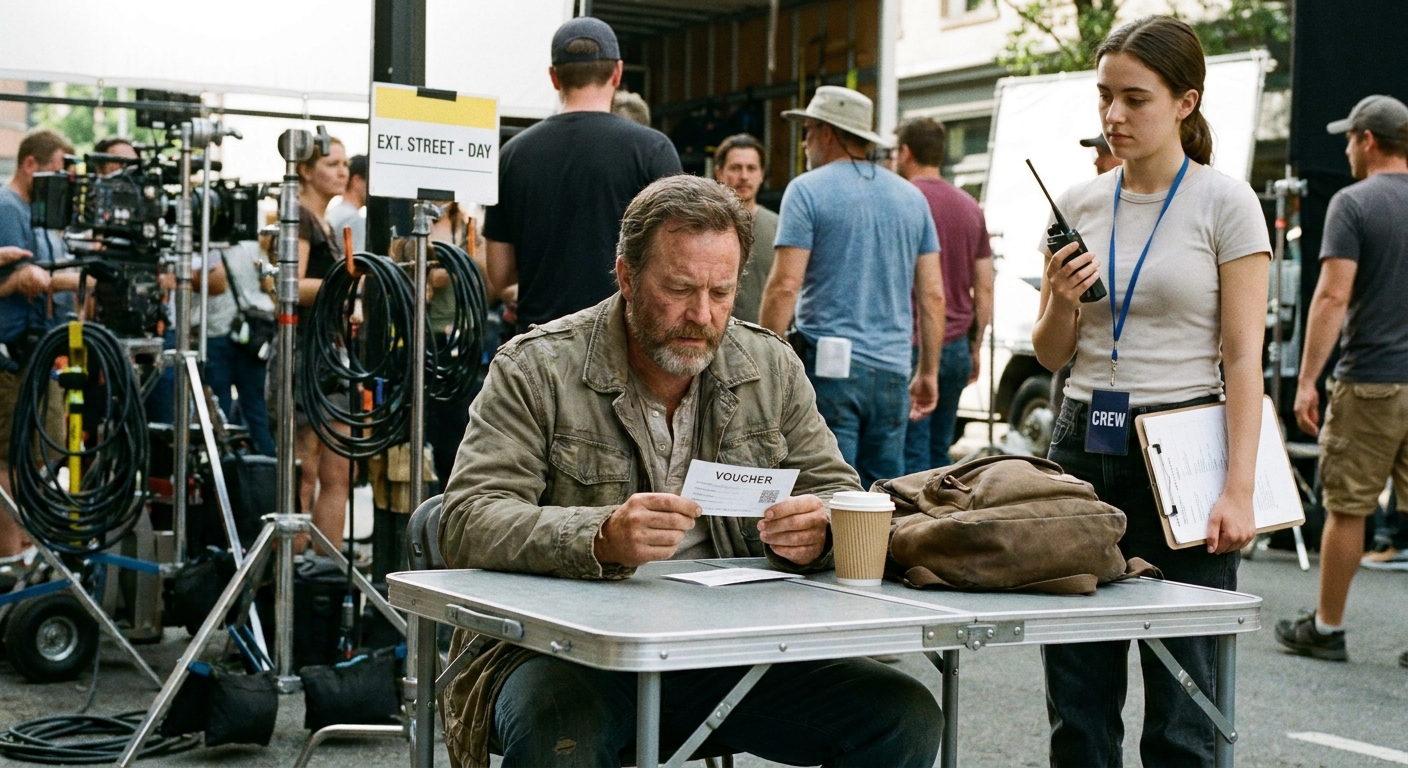
- Voucher: The time record for your day (paper or digital) that payroll uses to pay you.
- Guarantee: The minimum time or pay you are owed once you are hired and properly checked in, depending on the agreement.
- Bump: Extra pay for something specific (wardrobe, props, special ability, etc.).
- Meal penalty: Extra pay that can be triggered if a meal break is delayed beyond the allowed window.
- Wrap: When you are released for the day (your “out” time).
Union vs non-union
The fastest way to estimate your pay is figuring out whether your booking is under a union contract or a non-union agreement.
Union background (often SAG-AFTRA)
Most union background work in the U.S. is under SAG-AFTRA agreements. The exact terms depend on which agreement the production is signed to (theatrical, television, new media, low budget tiers, and more).
Union jobs tend to have:
- Higher guaranteed minimums for the day
- Clear overtime rules and penalties
- More consistent paperwork (vouchers, time tracking, deductions)
It is normal to hear a range even within the same city because the contract tier matters.
Non-union background
Non-union background pay is set by the production and local market norms, but it is still governed by state and local wage laws (minimum wage, reporting time pay in some places, required paid time for controlled work activities, and so on).
In practice, you will see:
- Pay quoted as an hourly rate (often with a minimum number of hours) or a flat day rate
- Overtime policies that may be less standardized and sometimes simply “included” in the flat rate
- More variability in whether there are bumps for special wardrobe, props, or difficult conditions
Do not guess. Some union-covered background bookings are communicated in shorthand or with sparse texts. If your booking does not clearly say union or name the agreement, ask background casting or payroll before you report.
Typical day rates
Because contracts and cities differ, it is more useful to think in typical ranges than a single universal number.
Union day rates (common pattern)
Union background is commonly described as an 8-hour guarantee, meaning you are paid at least the contract minimum for a set guaranteed period and then overtime can begin after that. The important fine print is that the guarantee, overtime triggers, and meal rules are contract-specific, so always defer to the agreement your production is using.
In many major U.S. production hubs, union background day rates commonly land in the low-to-mid hundreds per day for the base guarantee, before overtime and bumps, but your exact minimum depends on the specific SAG-AFTRA agreement and tier.
Non-union day rates (common pattern)
Non-union background varies dramatically by region and budget level, but many productions still structure pay around a day’s work and may quote something like:
- A flat day rate for a defined day length, or
- An hourly rate with a minimum (for example, a guaranteed number of hours even if you are wrapped early)
Non-union can be anywhere from “it’s a long day but decent” to “it barely covers parking.” The only reliable rule is: get the rate and the rules in writing in your booking confirmation.
Overtime and golden time
Background days have a habit of stretching. When they do, overtime rules decide whether your pay merely climbs or truly sprints.
Overtime basics
On union jobs, overtime generally begins after the guaranteed period and increases in steps. The details depend on the agreement, but a common structure is:
- Time-and-a-half for an initial block of overtime
- Double time after you pass certain thresholds
On non-union jobs, overtime might still exist, but it is not always standardized. Some productions pay an hourly rate where overtime kicks in after a defined hour count. Others pay a flat rate that assumes a long day. If you are unclear, ask payroll or the background PA before you sign out.
What people mean by “golden time”
“Golden time” is industry shorthand people use for late-hour overtime escalators that can kick in on some union-covered jobs once the day goes into truly long territory. There is not one universal “golden time” definition across every agreement or region, and the thresholds can vary.
The practical takeaway for extras is simple: on some union jobs, once a day goes very long, your hourly value can jump significantly. On non-union jobs, long days do not always translate into the same kind of escalation.
Meal breaks and penalties
Meals on set are their own genre, but they are also a pay issue.
Meal breaks
Productions typically schedule a meal break within a required window after your call time. The window depends on the contract and sometimes state labor rules, so do not assume the same timing from show to show.
Meal penalties
On many union-covered productions, if the meal is delayed beyond the allowed window, the production owes a meal penalty, which is additional pay added to your day. Some non-union productions also pay meal penalties, but you cannot assume it. If the job is non-union, confirm whether there are any meal penalties or whether late meals are simply part of the deal.
Wardrobe, props, and bumps
Background casting often asks for more than “bring your favorite jacket.” When your personal items or skills become production value, you may be eligible for extra pay, commonly called a bump.
Wardrobe bumps
You may see additional compensation when you are asked to provide:
- Specific wardrobe categories (period looks, formalwear, niche uniforms)
- Multiple complete options beyond standard “bring a few choices”
- Specialty items that save the costume department time or money
Whether a wardrobe bump exists and how much it is depends on the contract and the production’s policies. If you are asked to supply something unusually specific, it is fair to ask, politely, whether there is a wardrobe bump attached, and where it will be recorded on your voucher.
Prop bumps
If you are asked to bring a personal item that functions as a prop, such as a bike, musical instrument, sports equipment, or a distinctive vehicle, you may be offered additional pay. Because props can carry liability and logistical complications, productions often have rules about what can be used and whether it must be cleared by the prop department.
Special ability and upgrades
If background requires a particular skill, such as dancing, ice skating, or playing an instrument on camera, the production may treat the booking differently than standard background. The key is that it should be agreed upon before the workday, not discovered at wrap.
Also, if you are asked to do something that changes your classification (for example, you are given lines, or the production clearly treats you as more than general background), ask background casting or the on-set team how that will be handled. “Upgrade” rules are contract-specific, and you want the paperwork to match what you actually did.

Kit fees and gear
In some corners of the industry, “kit fee” means you are paid to provide and maintain specialized equipment. For background actors, this is less common than in crew departments, but it can come up in situations like:
- Providing a specialty uniform or gear that is costly and specific
- Being booked as background with a specific vehicle or high-value item
Use plain language when you ask questions: “Is there additional pay for bringing my own item?” If yes, confirm whether the bump is a flat amount and whether it applies if the item is used on camera or merely brought to set.
Fitting pay
Costume fittings are real work. If production requests a fitting on a separate day, that time is often paid on union jobs under set rules.
What fitting pay may cover
- A set amount of time or a minimum guarantee
- Sometimes travel considerations depending on contract and distance
On non-union productions, policies vary. In many places, if a fitting is required and you are under production’s control, it can be compensable time under wage and hour rules. Do not argue it in the fitting room. Just ask in advance whether the fitting is paid and how it will appear on your check.
Weather holds and cancellations
Film and TV schedules are weather’s favorite chew toy. Whether you get paid when plans change depends on what, exactly, the production does with your time, and on the rules that apply to that production.
Weather hold
If production books you and then holds the day due to weather, policies vary. Union agreements may have specific reporting pay or cancellation provisions. Non-union jobs may still be subject to state reporting-time pay laws in some jurisdictions. Always look at the language in your booking message and confirm with casting or payroll if it is unclear.
Cancellation calls
A cancellation can happen the night before or the morning of, especially for exterior scenes. Whether you get paid can depend on:
- How late the cancellation occurs
- Whether you were instructed to be “on standby”
- The union status, specific agreement, and any applicable state reporting pay rules
If you are canceled, keep the cancellation text or email. It can matter if you need to follow up with payroll.
Shortened days
If you are wrapped early, you may still receive a minimum guarantee (common on union jobs and sometimes on non-union jobs). That is why you will hear background actors say, with real affection, “We made the eight.”
What your paycheck looks like
Background pay is usually processed through a payroll company or the production’s payroll department. Two timelines matter: when your time is approved and when payroll runs.
When you usually get paid
Many productions pay background on a weekly or biweekly cycle. A common real-world experience is receiving payment about 1 to 3 weeks after the workday, though it can be faster or slower depending on the production, the payroll company, and whether there were any paperwork issues.
How you get paid
- Direct deposit is common if you are set up in the payroll system
- Paper checks still happen, especially for first-time paperwork or certain productions
Deductions
Even for one-day background work, your pay is generally subject to standard payroll deductions. Your take-home pay will be lower than the quoted gross.
Voucher checklist
Before you leave set, confirm the basics on your voucher (or digital sign-out):
- Correct name and contact info
- Your IN time (when you checked in) and OUT time (wrap)
- Meal time notes if your voucher tracks them
- Any bumps promised (wardrobe, props, special ability)
- Parking, mileage, or reimbursements if the production offers them
Background days can blur together. A quick photo of your completed voucher or a saved digital confirmation can save hours of follow-up later.
Quick pay scenarios
To make all of this feel less abstract, here are a few common scenarios and what changes the pay outcome.
Standard day
- Expect your base day rate or guaranteed minimum
- No bumps unless promised and recorded
Long day
- Union: overtime typically kicks in after the guarantee and may escalate to double time and, under some agreements, late-hour escalators people call “golden time”
- Non-union: overtime depends on the written terms and applicable wage laws, and sometimes a flat rate will not change
You bring a requested item
- You might receive a wardrobe or prop bump, but only if it was approved and recorded on your voucher
Separate fitting day
- Union jobs often pay fittings under set rules
- Non-union varies, but required, controlled time is often compensable. Confirm in advance with payroll
FAQ
Do extras get paid hourly or daily?
Both exist. Many jobs are structured as a day rate with a guaranteed number of hours, then overtime after that. Some non-union work is strictly hourly. Your booking confirmation and voucher should clarify which one applies.
Do extras get paid if they are sent home?
Sometimes. If you have been checked in, are on the call sheet, or your agreement includes a minimum guarantee, you may still be owed pay. If you were canceled before reporting, it depends on the production’s cancellation policy, any union rules, and in some places, state reporting-time pay laws.
Are meal penalties real money?
Yes, on productions where meal penalties apply. They are additional compensation triggered when the meal break is delayed beyond the allowed window, as defined by the agreement and sometimes local rules.
What should I do if a bump is missing from my check?
Start with payroll and keep it factual: provide the date worked, production name, your role classification, your IN and OUT times, and the bump you were promised. This is where keeping a copy or photo of your voucher helps.
Is extra pay the same everywhere?
No. Rates and rules can change by city, state, and contract, and they can also vary within the same city depending on whether the project is union, non-union, or a specific budget tier.