
I have a soft spot for background performers. They are the commuters on the platform, the museum-goers pausing at a painting, the wedding guests who clap on cue. When you are new to set life, though, the most unglamorous question can be the most urgent: are you being paid as an employee or as an independent contractor?
In many professional film and TV situations in the U.S., background performers are typically paid through payroll as employees for that day. That usually means taxes are withheld and you receive a W-2 at year’s end. But there are exceptions, misclassification does happen, and the fastest way to protect yourself is to know which documents hint at how you are being treated.

The common setup: payroll employees
If you are booked as an extra through a casting company or a production’s background casting team, you will often be processed like short-term, day-of employees. In practical terms, that can look like:
- You fill out onboarding and tax forms (often before the shoot day, sometimes at check-in).
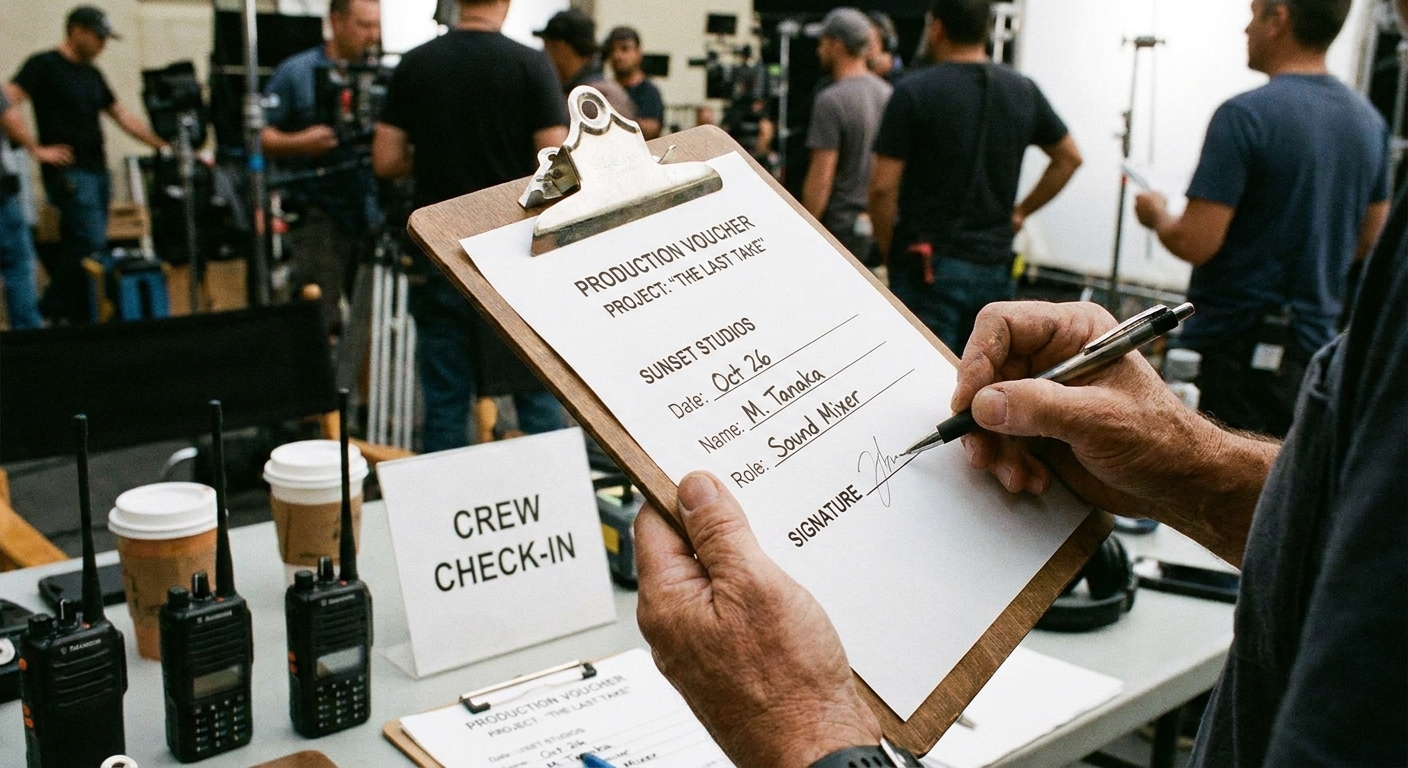
- You sign a timecard or voucher so payroll can track your hours and role.
- A payroll company or the production’s payroll department issues your payment.
This is especially common on union shows, studio projects, network series, and other productions that run things through established entertainment payroll vendors and union-style payroll practices.
W-2 vs 1099 for extras
W-2 (employee)
When you are treated as an employee for background work, you are generally paid via payroll with applicable withholdings, and you receive a Form W-2 for that employer at tax time (or access to it through the payroll provider’s portal).
For many extras, the key mental model is: you are hired for a specific production day, but you can still be an employee for that engagement.
1099 (independent contractor)
A 1099 is associated with independent contractor work, where the payer generally does not withhold taxes in the same way, and you are typically responsible for handling your own estimated taxes and self-employment considerations.
For background performers, a 1099 arrangement is less common on mainstream film and TV sets, but it can show up in certain corners of the industry, for example some non-union, ultra-low-budget, or nontraditional gigs. It can also appear when someone is not being hired specifically as background, but as a separate service provider (or through a loan-out company).
If someone tells you, “You’ll be 1099,” treat that as a cue to ask clarifying questions before you work the day, not after.
Where it shows up in paperwork
When you are standing in a folding-chair line at 5:30 a.m. clutching your coffee like it is a life raft, you want a quick way to see how production is planning to pay you. These are the documents that usually reveal it.
1) The tax form you are asked to complete
- W-4 usually signals employee status for payroll.
- W-9 usually signals independent contractor status.
It is often that simple at first glance. Still, forms are an indicator, not the legal test. A production may collect tax info through a payroll portal without handing you a classic paper W-4, and a W-9 can show up for other payee setups. If you are handed a W-9 at check-in for routine extra work, ask why.
2) Your onboarding email or payroll portal invite
Many productions use a payroll company, and your onboarding email may reference employee onboarding language, I-9 requirements, or a payroll portal. If the workflow looks like employee onboarding, it is pointing toward W-2 employment even if you never physically touch a W-4.
3) The voucher or timecard you sign
Background performers commonly sign a voucher or timecard that tracks call time, wrap time, meal breaks, and role notes. While a voucher is not a tax document, it often includes payroll identifiers, payroll company information, and terms that line up with being paid through payroll.
It can change job to job
One thing that trips people up is thinking classification is a permanent identity, like you are either “a W-2 person” or “a 1099 person.” In entertainment work, classification is often tied to the specific engagement and the specific payer.
That means you might be a W-2 employee for background work on a series this week, and then do a totally different kind of gig later that is handled differently.
Also, a quiet but important caveat: what the paperwork says is not always what the law would say. Legal classification generally depends on the realities of the work, like who controls the job and how the work is structured, plus state and federal rules. Paperwork is a clue, not a verdict.
Who is the “employer”?
For extras, the “employer” listed on your year-end paperwork is often the payroll company or the production entity that processed payroll, not necessarily the casting company that booked you or the show title you tell your friends about.
This matters when you are hunting for your W-2 later. If you cannot find it, search your email for payroll onboarding, portals, or the payroll provider name used at check-in.
What to do at check-in
You do not have to become the world’s driest person at the holding tent, but you can ask clean, professional questions. I have watched seasoned background performers do this with zero drama, just calm competence.
- Ask who payroll is through. “Which payroll company is issuing payment for this job?”
- Ask what setup they are using. “Am I being paid through payroll as an employee, or as a contractor?”
- Ask what forms you should expect. “Should I expect employee onboarding forms like a W-4 and I-9, or a W-9?”
- Keep copies or photos of what you sign. Vouchers, deal memos, and onboarding confirmations are your breadcrumbs later.
If something feels inconsistent, for example you are being treated like crew without crew paperwork, or asked for contractor forms in a context that is usually payroll, it is reasonable to request clarification before you work.
If it becomes a pattern and you suspect you are being misclassified, start by asking for the payroll contact (or the production’s payroll email) so you can get the answer in writing. And if you are still unsure, consider talking to a qualified tax professional or your state labor agency. You do not have to litigate it in the breakfast line.
A quick note about I-9s
If you are being hired as an employee, an I-9 (employment eligibility verification) is commonly part of onboarding at some point. Many payroll companies keep an I-9 on file for a period of time, so you may not fill one out for every single production day. The presence of I-9 onboarding language usually lines up with W-2 employee processing.
FAQ
Are most film and TV extras W-2 employees?
Often, yes, especially on studio, network, and other professionally run sets that use entertainment payroll companies. Many background performers are paid through payroll as short-term employees and receive W-2s from the payroll provider or production entity.
Can an extra be paid on a 1099?
It can happen, but it is less common in standard film and TV background work. If you are told you will be 1099, ask which entity is paying you and why the job is being handled as contractor work.
Which document tells me W-2 vs 1099?
Start with the tax form: a W-4 usually points to W-2 employee payroll, while a W-9 usually points to 1099 contractor treatment. But it is not foolproof. Some productions collect tax info digitally, and in some situations a W-9 can be used for payees that are not “you as a day-player extra.” Use forms as a signal, then confirm with payroll if anything seems off.
Is my voucher the same thing as a contract?
A voucher is usually a payroll and timekeeping document rather than a full contract, but it is still important. It can help show who paid you, what production you worked, and what you attested to at check-in.
What should I do if I think I am misclassified?
Ask for the payroll contact and request clarification about how you are being paid and what year-end form you should expect. Save your voucher and onboarding emails. If you are repeatedly being pushed into contractor paperwork for routine background work and it does not add up, consider getting advice from a tax professional or contacting your state labor agency.
The bottom line
On many professional sets, film and TV extras are paid as employees through payroll, not as independent contractors. The fastest way to get oriented is to look at what you are asked to fill out and how onboarding is described: a W-4 and payroll onboarding usually mean W-2, and a W-9 usually means 1099.
And when in doubt, keep it simple: ask who payroll is through, save your onboarding confirmation, and hold onto your voucher. Your future self, the one staring at a tax portal in January, will thank you.